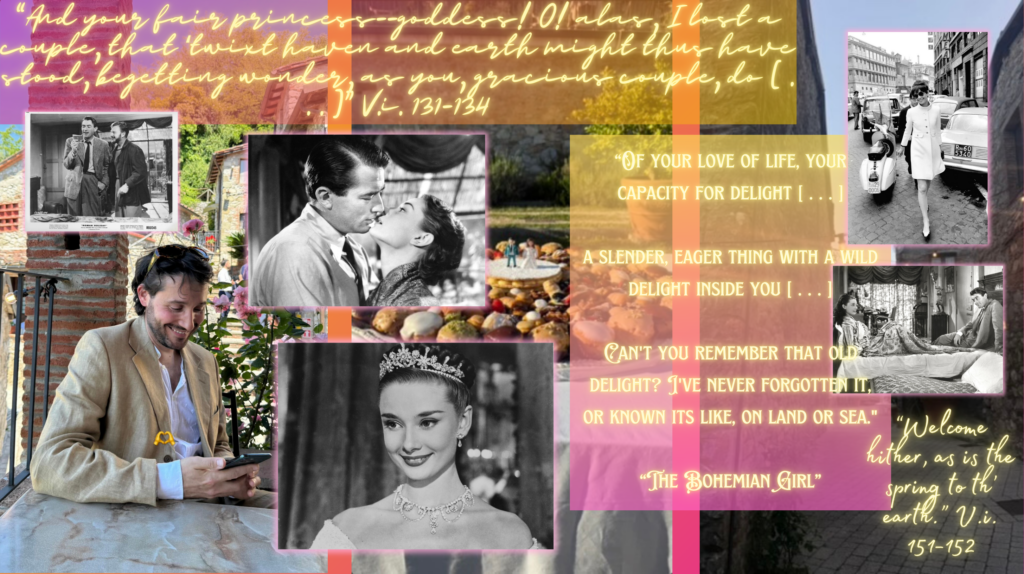

THE EFFECT OF THE BOHEMIAN GIRL
IT TAKES A MASTER OF WRITING, OF FILMMAKING, AND Of JOYOUS BEAUTY: WILLA CATHER’S VISION AND OF HER BEINGNESS, WILLIAM WYLER’S KNOWING EXACTLY WHAT IT TAKES AND HOW TO BRING IT ALL OUT, AND AUDREY HEPBURN SET FREE TO BE HERSELF. AND THEN IT OPENS, THAT SPACE OF MAGIC PLAY OF THE MIXTURE BETWEEN HEAVEN AND EARTH . . .
And now, the beings of that unforgettable effect
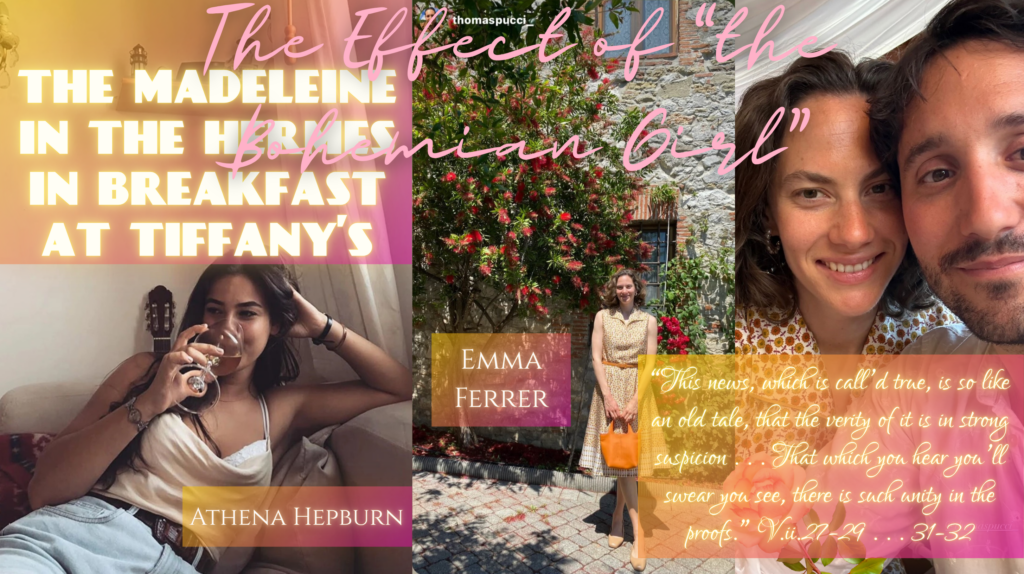
The Madeleine(s) in the Hermes in breakfast at tiffany’s
ATHENA HEPBURN AND EMMA FERRER
“This news, which is call’d true, is so like an old tale, that the verity of it is in strong suspicion . . . That which you hear you’ll swear you see, there is such unity in the proofs.” the winter’s tale V.ii. 27-29 . . . 31-32
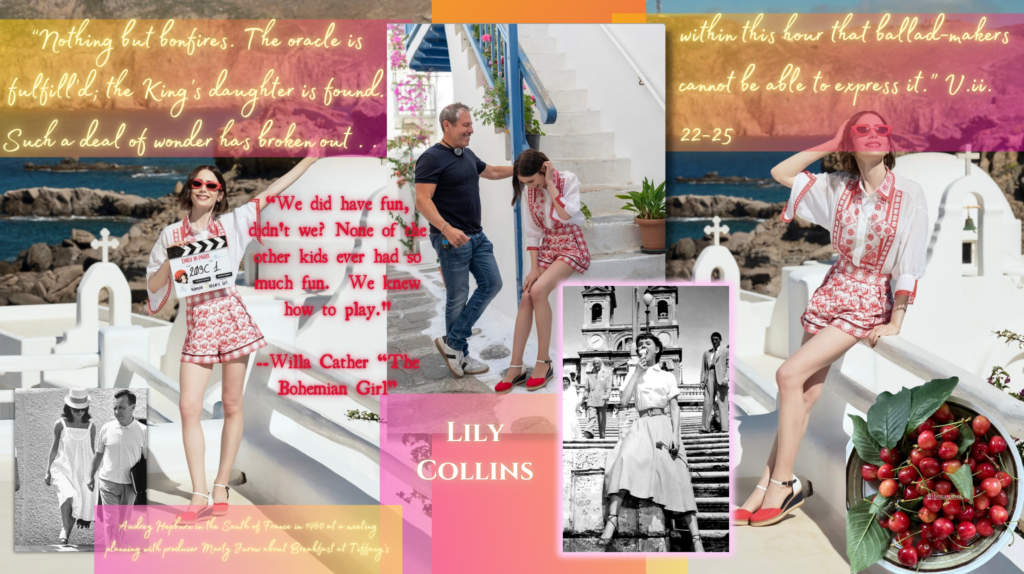
LILY COLLINS
“Nothing but bonfires. The oracle is fulfill’d; the King’s daughter is found. Such a deal of wonder has broken out within this hour that ballad-makers cannot be able to express it.” V.ii. 22-25
“We did have fun, didn’t we? None of the other kids ever had so much fun. We knew how to play.”–Willa Cather “The Bohemian Girl”
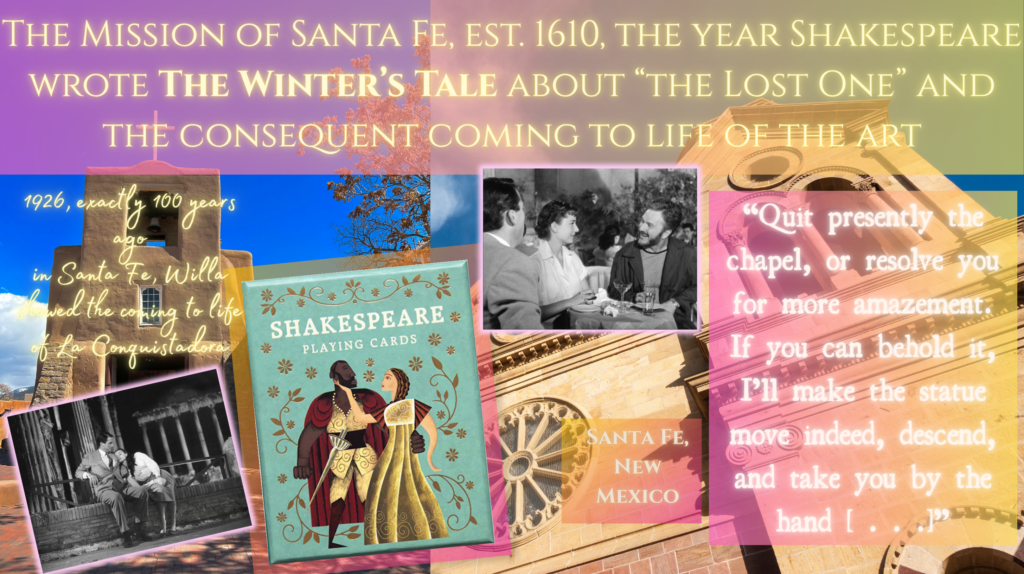
The Mission of Santa Fe, est. 1610, the year Shakespeare wrote The Winter’s Tale about “the Lost One” and the consequent coming to life of the art
1926, exactly 100 years ago in Santa Fe, Willa showed the coming to life of La Conquistadora
“Quit presently the chapel, or resolve you for more amazement. If you can behold it, I’ll make the statue move indeed, descend, and take you by the hand [ . . .]”
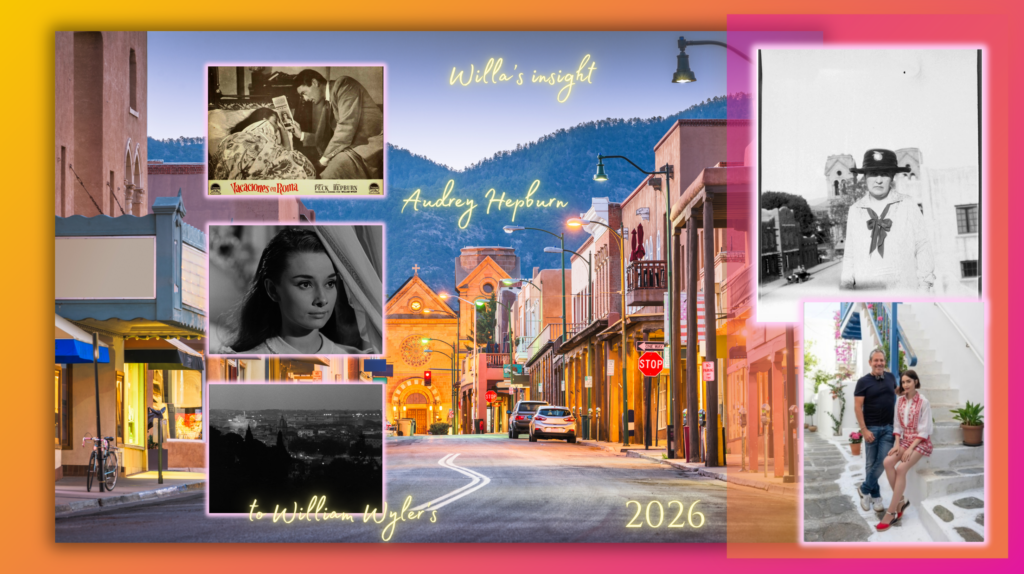
Willa’s insight to William Wylers, with Audrey Hepburn to Lily Collins
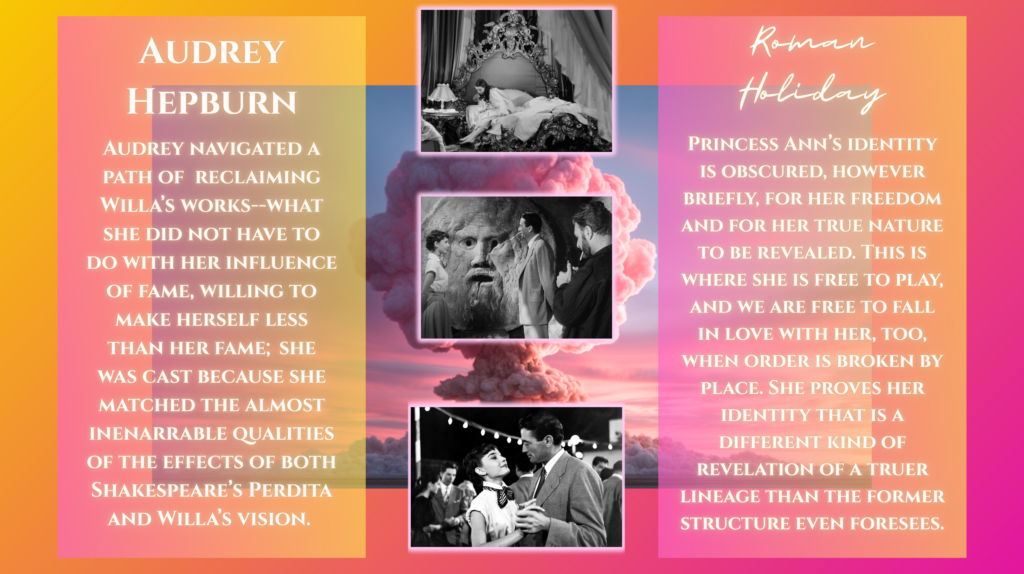
Audrey hepburn & Roman Holiday
Audrey navigated a path of reclaiming Willa’s works–what she did not have to do with her influence of fame, willing to make herself less than her fame; she was cast because she matched the almost inenarrable qualities of the effects of both Shakespeare’s Perdita and Willa’s vision.
Princess Ann’s identity is obscured, however briefly, for her freedom and for her true nature to be revealed. This is where she is free to play, and we are free to fall in love with her, too, when order is broken by place. She proves her identity that is a different kind of revelation of a truer lineage than the former structure even foresees.
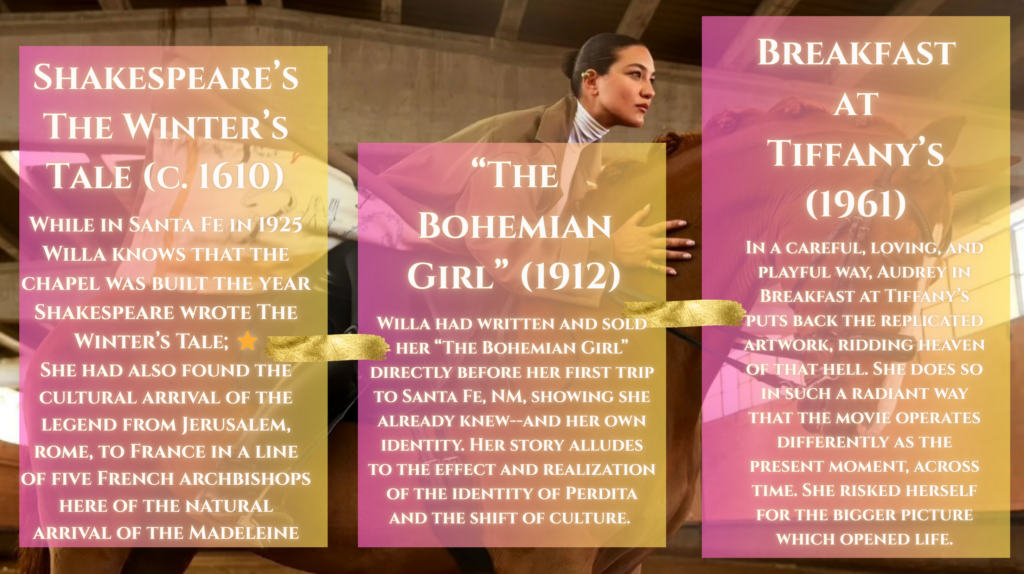
Shakespeare’s The Winter’s Tale (c. 1610)
While in Santa Fe in 1925 Willa knows that the chapel was built the year Shakespeare wrote The Winter’s Tale; She had also found the cultural arrival of the legend from Jerusalem, rome, to France in a line of five French archbishops here of the natural arrival of the Madeleine.
“The Bohemian Girl” (1912)
Willa had written and sold her “The Bohemian Girl” directly before her first trip to Santa Fe, NM, showing she already knew–and her own identity. Her story alludes to the effect and realization of the identity of Perdita and the shift of culture.
Breakfast at Tiffany’s (1961)
In a careful, loving, and playful way, Audrey in Breakfast at Tiffany’s puts back the replicated artwork, ridding heaven of that hell. She does so in such a radiant way that the movie operates differently as the present moment, across time. She risked herself for the bigger picture which opened life.
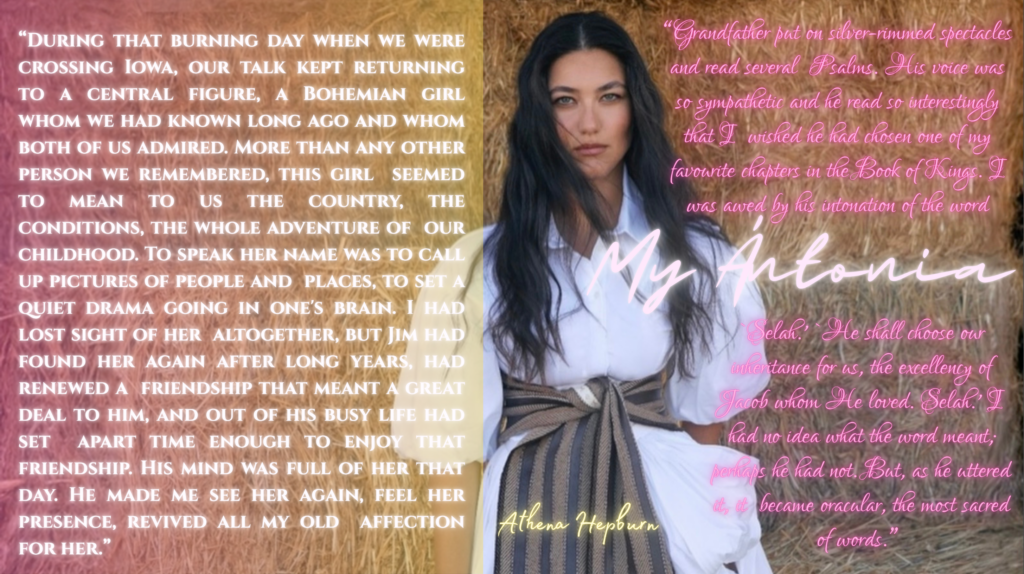
Athena hepburn, My Ántonia
“During that burning day when we were crossing Iowa, our talk kept returning to a central figure, a Bohemian girl whom we had known long ago and whom both of us admired. More than any other person we remembered, this girl seemed to mean to us the country, the conditions, the whole adventure of our childhood. To speak her name was to call up pictures of people and places, to set a quiet drama going in one’s brain. I had lost sight of her altogether, but Jim had found her again after long years, had renewed a friendship that meant a great deal to him, and out of his busy life had set apart time enough to enjoy that friendship. His mind was full of her that day. He made me see her again, feel her presence, revived all my old affection for her.”
“Grandfather put on silver-rimmed spectacles and read several Psalms. His voice was so sympathetic and he read so interestingly that I wished he had chosen one of my favourite chapters in the Book of Kings. I was awed by his intonation of the word `Selah.’ `He shall choose our inheritance for us, the excellency of Jacob whom He loved. Selah.’ I had no idea what the word meant; perhaps he had not. But, as he uttered it, it became oracular, the most sacred of words.”
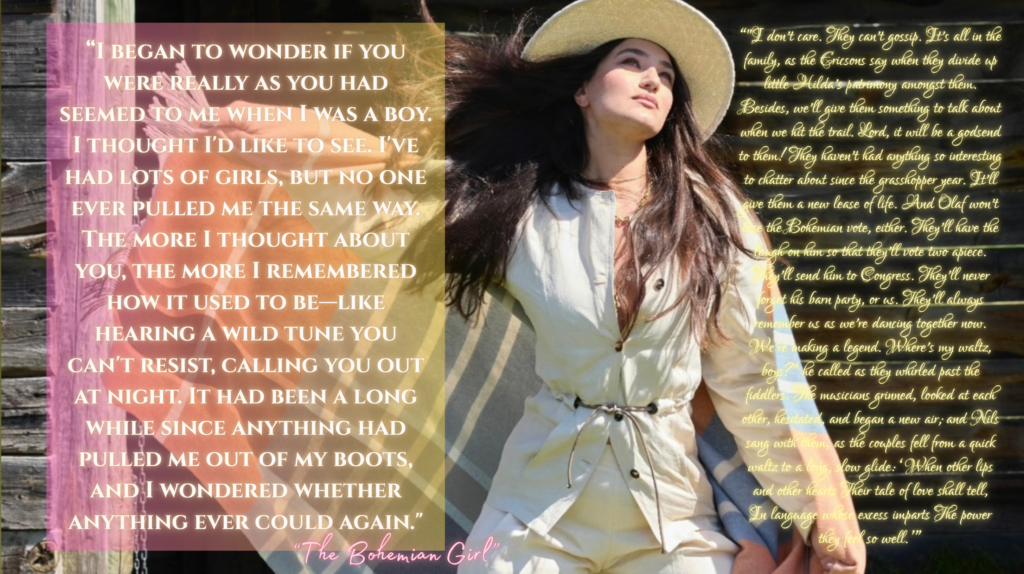
“The Bohemian Girl”
“I began to wonder if you were really as you had seemed to me when I was a boy. I thought I’d like to see. I’ve had lots of girls, but no one ever pulled me the same way. The more I thought about you, the more I remembered how it used to be—like hearing a wild tune you can’t resist, calling you out at night. It had been a long while since anything had pulled me out of my boots, and I wondered whether anything ever could again.”
“‘I don’t care. They can’t gossip. It’s all in the family, as the Ericsons say when they divide up little Hilda’s patrimony amongst them. Besides, we’ll give them something to talk about when we hit the trail. Lord, it will be a godsend to them! They haven’t had anything so interesting to chatter about since the grasshopper year. It’ll give them a new lease of life. And Olaf won’t lose the Bohemian vote, either. They’ll have the laugh on him so that they’ll vote two apiece. They’ll send him to Congress. They’ll never forget his barn party, or us. They’ll always remember us as we’re dancing together now. We’re making a legend. Where’s my waltz, boys?’ he called as they whirled past the fiddlers. The musicians grinned, looked at each other, hesitated, and began a new air; and Nils sang with them, as the couples fell from a quick waltz to a long, slow glide: ‘When other lips and other hearts Their tale of love shall tell, In language whose excess imparts The power they feel so well.’”
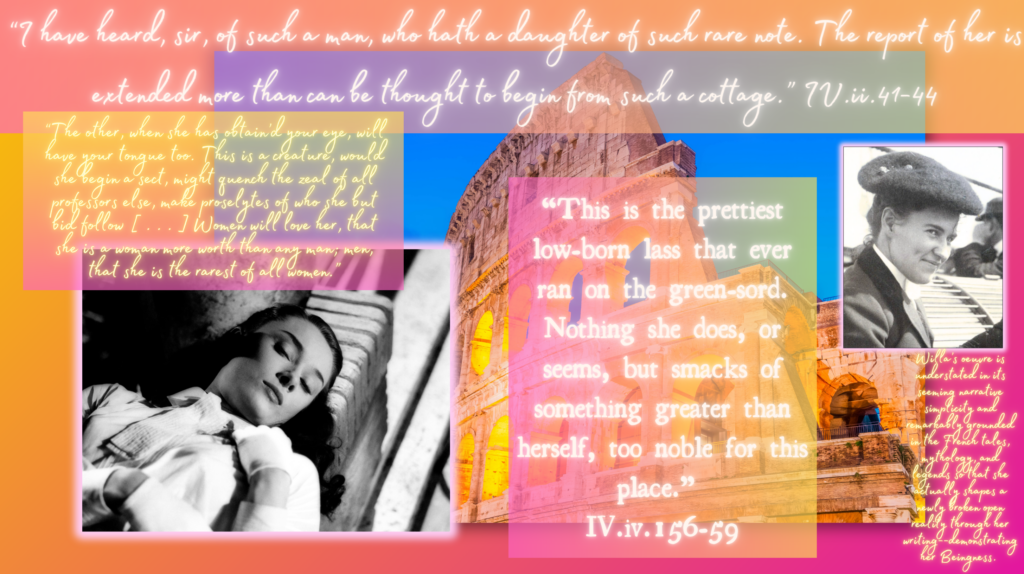
“I have heard, sir, of such a man, who hath a daughter of such rare note. The report of her is extended more than can be thought to begin from such a cottage.” IV.ii.41-44
“The other, when she has obtain’d your eye, will have your tongue too. This is a creature, would she begin a sect, might quench the zeal of all professors else, make proselytes of who she but bid follow [ . . . ] Women will love her, that she is a woman more worth than any man; men, that she is the rarest of all women.” The Winter’s Tale
“This is the prettiest low-born lass that ever ran on the green-sord. Nothing she does, or seems, but smacks of something greater than herself, too noble for this place.” IV.iv. 156-59
Willa’s oeuvre is understated in its seeming narrative simplicity and remarkably grounded in the French tales, mythology, and legends so that she actually shapes a newly broken open reality through her writing–demonstrating her Beingness.
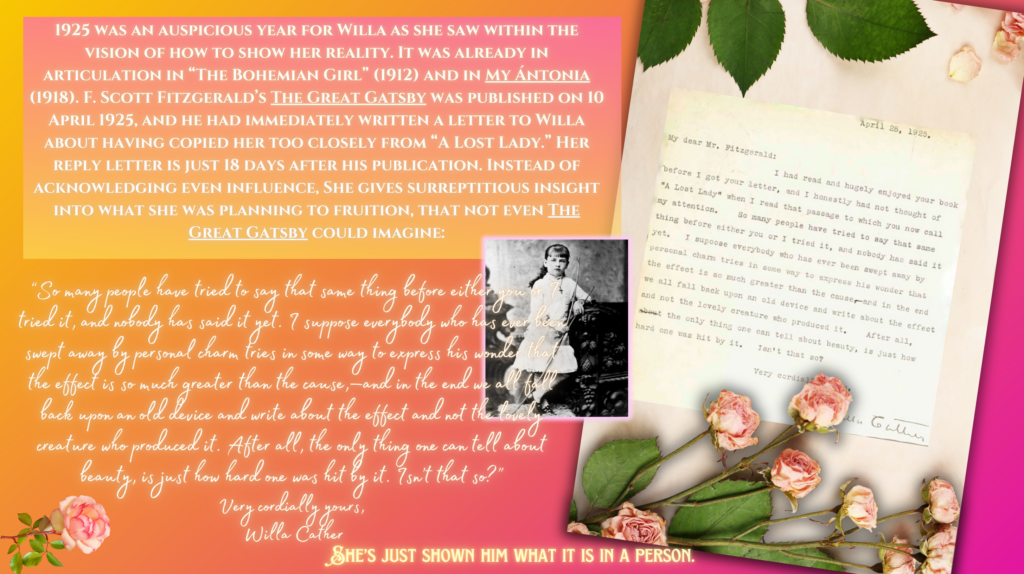
1925 was an auspicious year for Willa as she saw within the vision of how to show her reality. It was already in articulation in “The Bohemian Girl” (1912) and in My Ántonia (1918). F. Scott Fitzgerald’s The Great Gatsby was published on 10 April 1925, and he had immediately written a letter to Willa about having copied her too closely from “A Lost Lady.” Her reply letter is just 18 days after his publication. Instead of acknowledging even influence, She gives surreptitious insight into what she was planning to fruition, that not even The Great Gatsby could imagine:
“So many people have tried to say that same thing before either you or I tried it, and nobody has said it yet. I suppose everybody who has ever been swept away by personal charm tries in some way to express his wonder that the effect is so much greater than the cause,—and in the end we all fall back upon an old device and write about the effect and not the lovely creature who produced it. After all, the only thing one can tell about beauty, is just how hard one was hit by it. Isn’t that so?” Very cordially yours, Willa Cather
She’s just shown him what it is in a person.
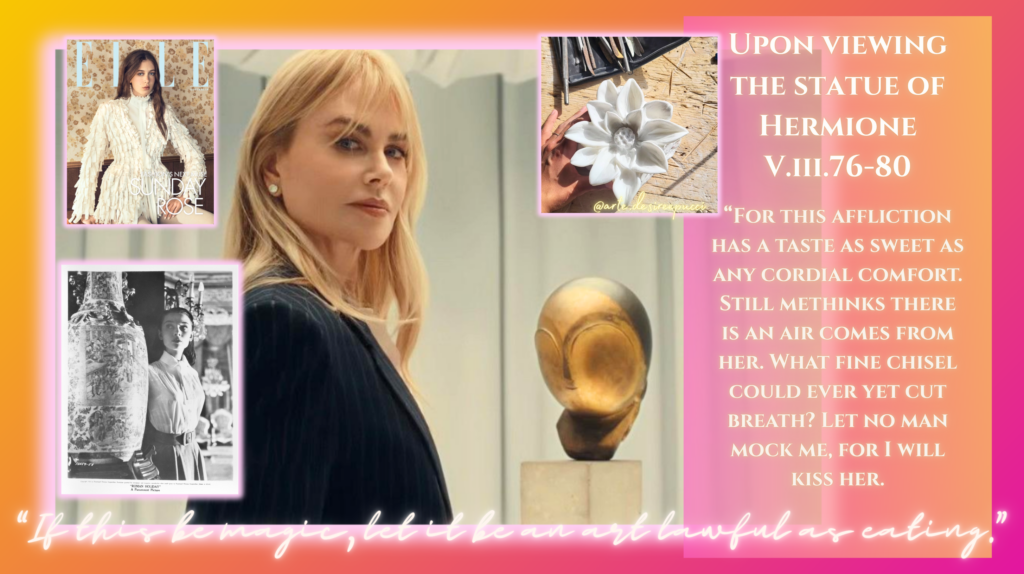
Audrey Hepburn, Nicole kidman, Sunday Rose Kidman Urban
Upon viewing the statue of Hermione V.iii. 76-80
“For this affliction has a taste as sweet as any cordial comfort. Still methinks there is an air comes from her. What fine chisel could ever yet cut breath? Let no man mock me, for I will kiss her.”
“If this be magic, let it be an art lawful as eating.”
Flower sculpture, Desirée Pucci
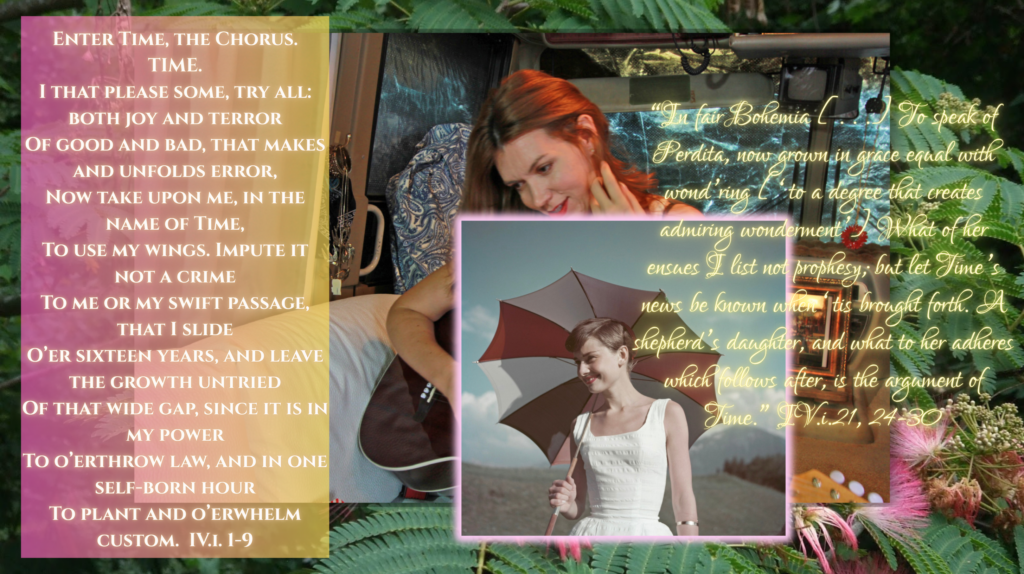
Enter Time, the Chorus.
TIME.
I that please some, try all: both joy and terror
Of good and bad, that makes and unfolds error,
Now take upon me, in the name of Time,
To use my wings. Impute it not a crime
To me or my swift passage, that I slide
O’er sixteen years, and leave the growth untried
Of that wide gap, since it is in my power
To o’erthrow law, and in one self-born hour
To plant and o’erwhelm custom. IV.i. 1-9
“In fair Bohemia [. . .] To speak of Perdita, now grown in grace equal with wond’ring [‘to a degree that creates admiring wonderment’] What of her ensues I list not prophesy; but let Time’s news be known when ‘tis brought forth. A shepherd’s daughter, and what to her adheres which follows after, is the argument of Time.” IV.i.21, 24-30
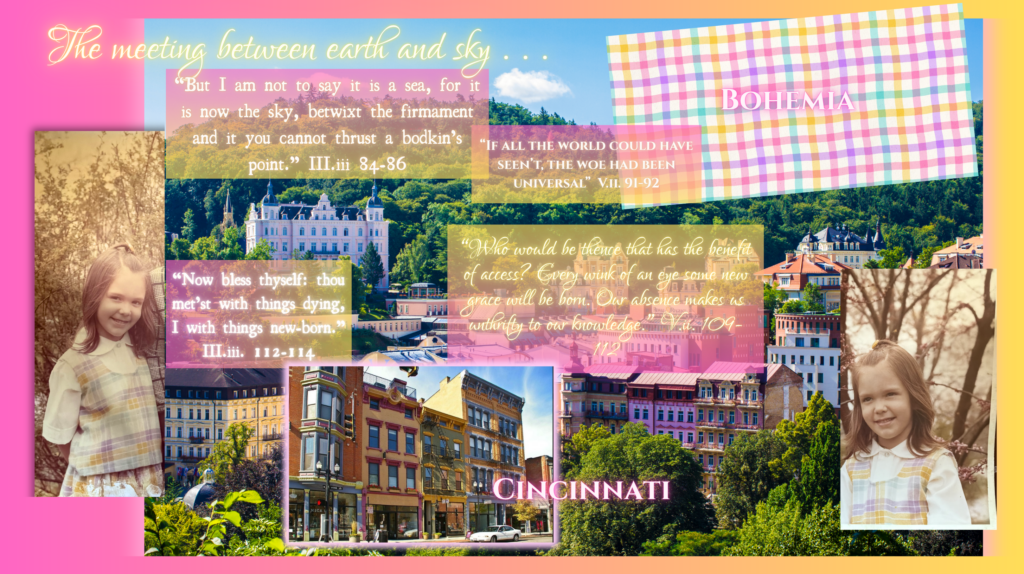
The meeting between earth and sky . . .
Bohemia, the Festive setting of the second half of The winter’s tale, and the land of my Ancestors before they immigrated to Cincinnati, my birthplace
“But I am not to say it is a sea, for it is now the sky, betwixt the firmament and it you cannot thrust a bodkin’s point.” III.iii 84-86
“If all the world could have seen’t, the woe had been universal” V.ii. 91-92
“Now bless thyself: thou met’st with things dying, I with things new-born.” III.iii. 112-114
“Who would be thence that has the benefit of access? Every wink of an eye some new grace will be born. Our absence makes us unthrifty to our knowledge.” V.ii. 109-112
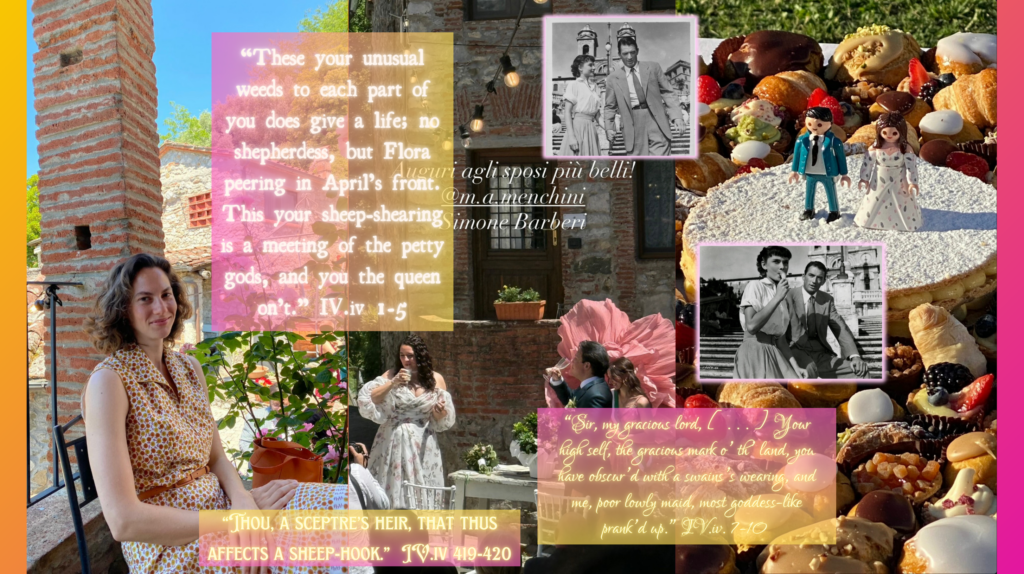
“These your unusual weeds to each part of you does give a life; no shepherdess, but Flora peering in April’s front. This your sheep-shearing is a meeting of the petty gods, and you the queen on’t.” IV.iv 1-5
“Sir, my gracious lord, [ . . . ] Your high self, the gracious mark o’ th’ land, you have obscur’d with a swains’s wearing, and me, poor lowly maid, most goddess-like prank’d up.” IV.iv. 7-10
“Thou, a sceptre’s heir, that thus affects a sheep-hook.” IV.iv 419-420