

PROVIDENCE AT PLAY
A Glimpse into how the artistic & Eternal, when done in a certain spirit, operate the same way
A Love Affair, in all its meanings of PLAY Across the unbarred distance of time and space, and for the sake of art, and its now certain, discernible, eternal effects for humanity
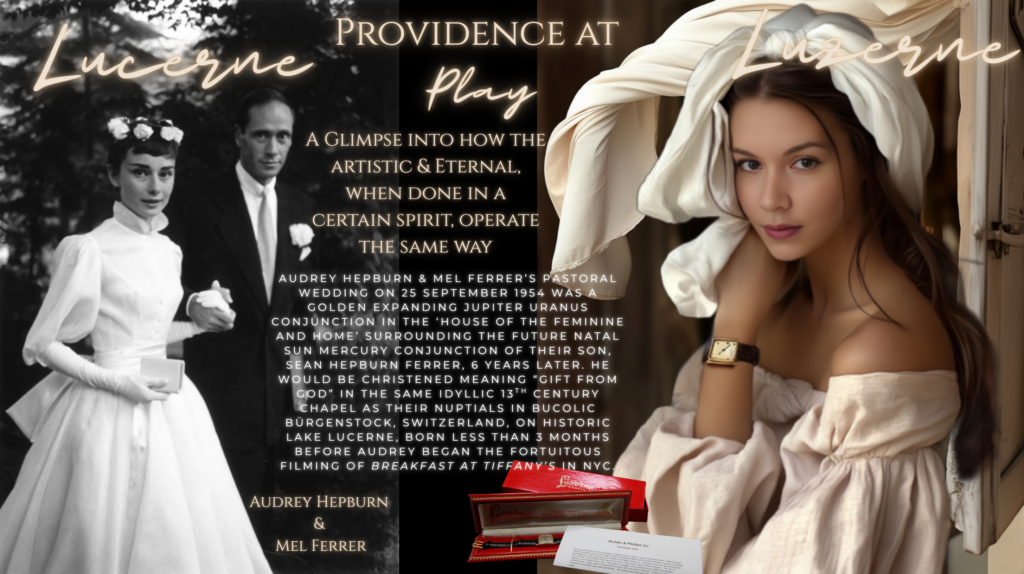
Audrey Hepburn & Mel Ferrer’s pastoral wedding on 25 September 1954 was a golden expanding Jupiter Uranus conjunction in the ‘house of the feminine and home’ surrounding the future natal sun Mercury conjunction of their son, Sean Hepburn Ferrer, 6 years later. He would be christened meaning “Gift from God” in the same idyllic 13th century chapel as their nuptials in bucolic Bürgenstock, Switzerland, on historic Lake Lucerne, born less than 3 months before Audrey began the fortuitous filming of Breakfast at Tiffany’s in NYC.
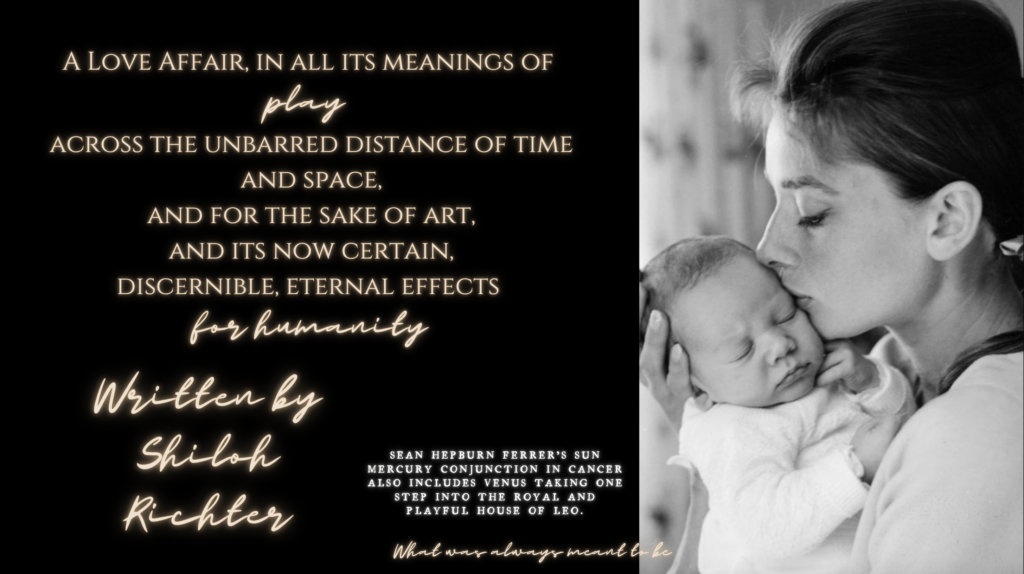
Sean Hepburn Ferrer’s Sun Mercury conjunction in Cancer also includeS Venus taking one step into the royal and playful house of Leo.
What was always meant to be.
What would you sacrifice of yourself and your life if you had the chance for humanity? when the decisive moment arose with John Mayer 16 years ago at our beginning . . . it was evident the possibilities of changing the world could actually happen, if we held on to what we knew deepest and best . . .
It required looking beyond “what happens”–any kind of story “plot” (that even as Shakespeare shows has its necessary end from its chosen plot), and pay diligence to the spirit in which things are done instead, free of, outside of, and beyond plot.
–for John that is community bonds and music and the far and important reaches of that, where only Song can go.
(I had to go into the inner chamber alone, to nature, with my little ones, and from that center, writing.)
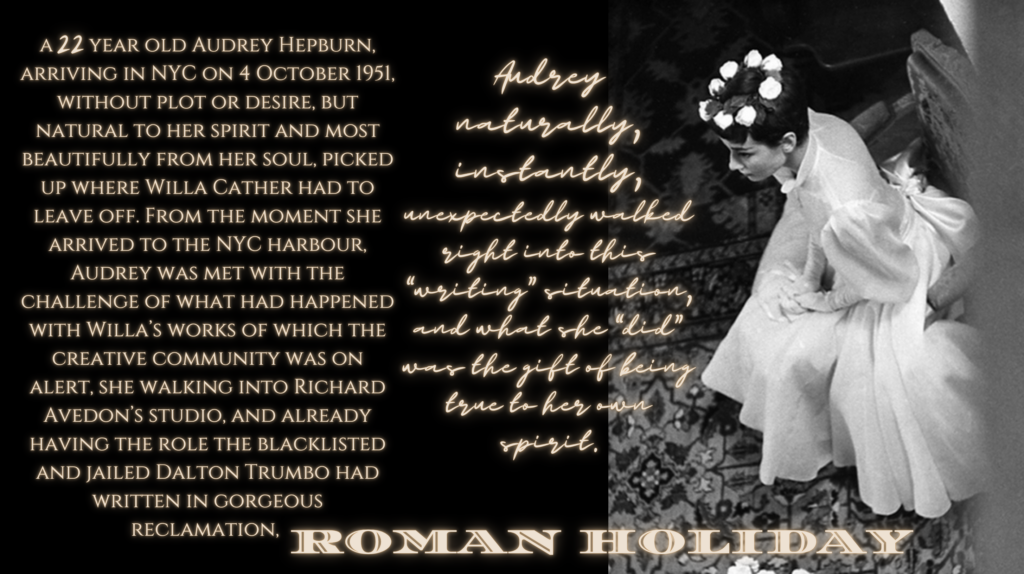
A 22 year old Audrey Hepburn, arriving in NYC on 4 October 1951, without plot or desire [for fame], but natural to her spirit and most beautifully from her soul, picked up where Willa Cather had to leave off. From the moment she arrived to the NYC harbour, Audrey was met with the challenge of what had happened with Willa’s works of which the creative community was on alert, she walking into Richard Avedon’s studio, and already having the role the black-listed and jailed Dalton Trumbo had written in gorgeous reclamation,
Audrey naturally, instantly, unexpectedly walked right into this “writing” situation, and what she “did” was the gift of being true to her own spirit.
The way that tales and legends transfer as the eternal of humanity into culture, for example, Willa studied, deliver a far different, real effect than the gossip-like effect of yesterday’s news of “what happened,” what “someone did.”
Willa Cather studied writing and art her whole life and saw the ways in which it was operating beyond “plot” or drama–just ”what happens”–especially with the French masters.
These were not just theories about writing and literature to her, as she saw how its French spirit, even the play of the French language, was actually determining the more unbounded reality of personhood and culture where life itself bloomed.
And in this Willa also was witnessing the emptying of these very things in American life in the early 20th century, actually crushing out this crucial spirit for vacant and harmful lack of spirit, the killing off of the spirit of what came from old Europe.
“Almost no writer dares write except as if he or she had something to sell.” –Willa Cather
(The text of “Truman Capote’s Novel” Breakfast at Tiffany’s was “written” while he was hidden away from view as he lifted it from Willa Cather’s stories “The Bohemian Girl,” “Coming, Aphrodite!,” The Song of the Lark, and My Antonia.)
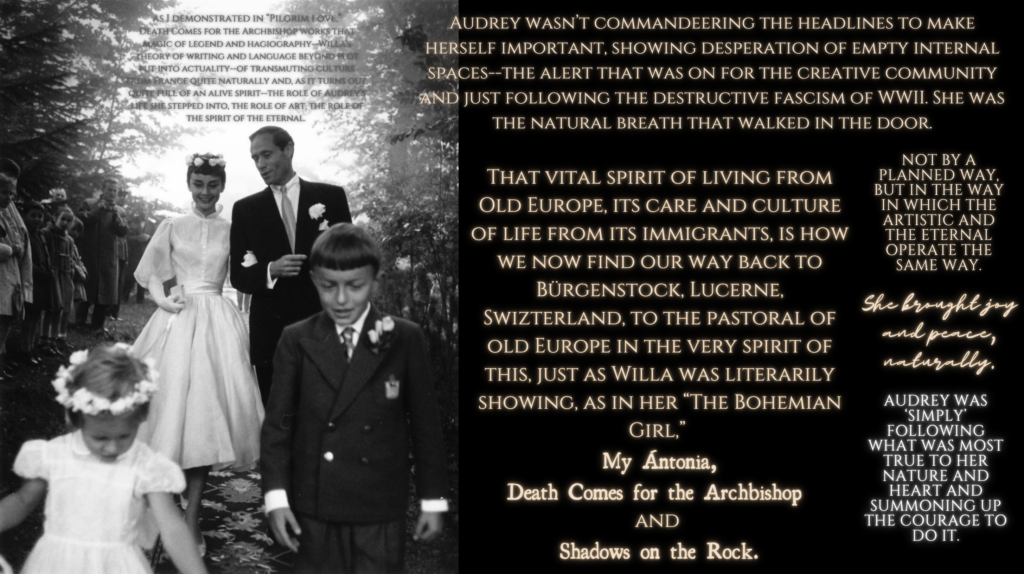
As I demonstrated in “Pilgrim Love,” Death Comes for the Archbishop works that magic of legend and hagiography–Willa’s theory of writing and language beyond plot put into actuality–of transmuting culture from France quite naturally and, as it turns out, quite full of an alive spirit–the role of Audrey’s life she stepped into, the role of art, the role of the spirit of the eternal.
Audrey wasn’t commandeering the headlines to make herself important, showing desperation of empty internal spaces–the alert that was on for the creative community and just following the destructive fascism of WWII. She was the natural breath that walked in the door.
Not by a planned way, but in the way in which the artistic and the eternal operate the same way.
She brought joy and peace, naturally.
Audrey was ‘simply’ following what was most true to her nature and heart and summoning up the courage to do it.
That vital spirit of living from old Europe, its care and culture of life from its immigrants, is how we now find our way back to Bürgenstock, Lucerne, Swizterland, to the pastoral of old Europe in the very spirit of this, just as Willa was literarily showing, as in her “The Bohemian Girl,” My Ántonia, Death Comes for the Archbishop, and Shadows on the Rock.
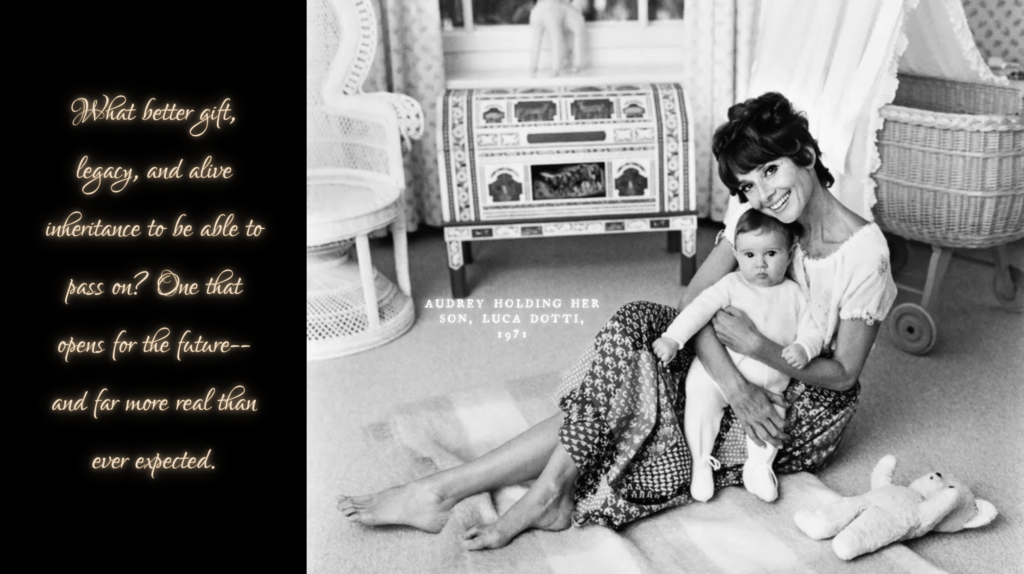
What better gift, legacy, and alive inheritance to be able to pass on? One that opens for the future–and far more real than ever expected.
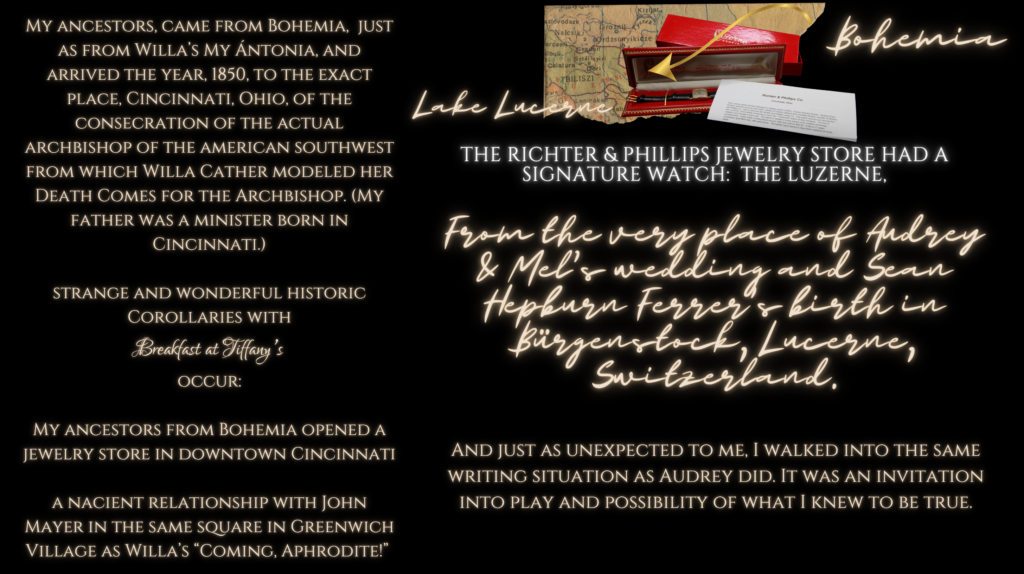
My ancestors, came from Bohemia, just as from Willa’s My Ántonia, and arrived the year, 1850, to the exact place, Cincinnati, Ohio, of the consecration of the actual archbishop of the american southwest from which Willa Cather modeled her Death Comes for the Archbishop. (My father was a minister born in Cincinnati.) Strange and wonderful historic corollaries with Breakfast at Tiffany’s occur:
My ancestors from Bohemia opened a jewelry store in downtown Cincinnati, a nacient relationship with John Mayer in the same square in Greenwich Village as Willa’s “Coming, Aphrodite!”
The Richter & Phillips jewelry store had a signature watch: the Luzerne, from [and named for] the very place of Audrey & Mel’s wedding and Sean Hepburn Ferrer’s birth in Bürgenstock, Lucerne, Switzerland.
And just as unexpected to me, I walked into the same writing situation as Audrey did. It was an invitation into play and possibility of what I knew to be true.
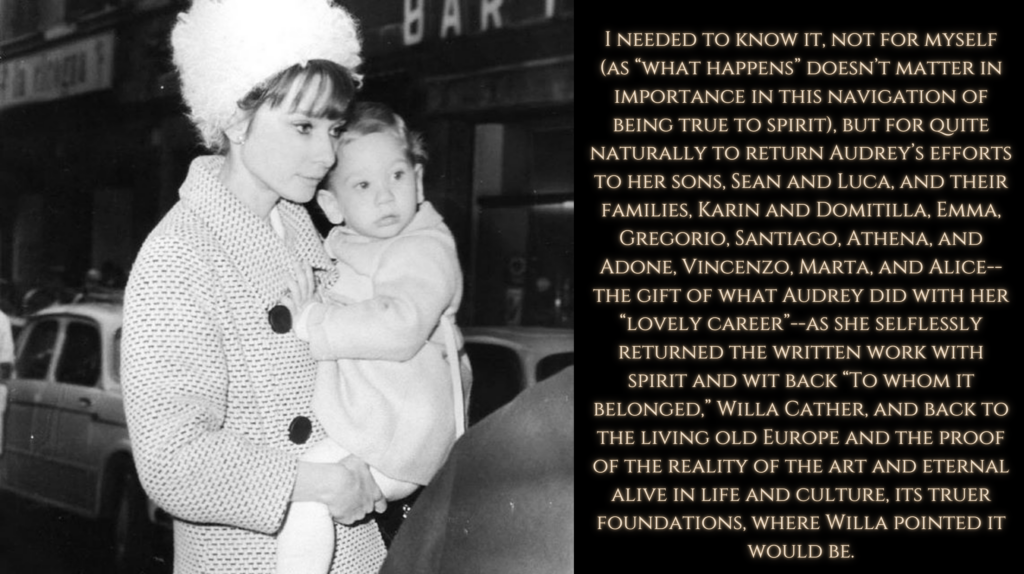
I needed to know it, not for myself [alone] (as “what happens” doesn’t matter in importance in this navigation of being true to spirit), but for quite naturally to return Audrey’s efforts to her sons, Sean and Luca, and their families, Karin and Domitilla, Emma, Gregorio, Santiago, Athena, and Adone, Vincenzo, Marta, and Alice–the gift of what Audrey did with her “lovely career”–as she selflessly returned the written work with spirit and wit back “to whom it belonged,” Willa Cather, and back to the living old Europe and the proof of the reality of the art and eternal alive in life and culture, its truer foundations, where Willa pointed it would be.
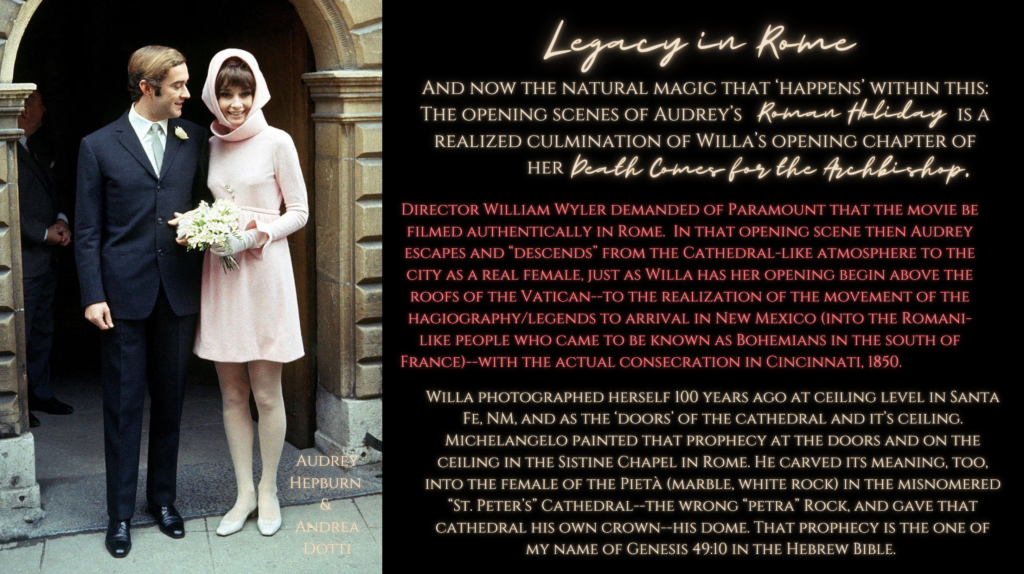
Legacy in Rome
And now the natural magic that ‘happens’ within this: The opening scenes of Audrey’s is a realized culmination of Willa’s opening chapter of her Death Comes for the Archbishop.
Director William Wyler demanded of Paramount that the movie be filmed authentically in Rome. In that opening scene then Audrey escapes and “descends” from the cathedral-like atmosphere to the city as a real female, just as Willa has her opening begin above the roofs of the Vatican–to the realization of the movement of the hagiography/legends to arrival in New Mexico (into the Romani-like people who came to be known as Bohemians in the south of France)–with the actual consecration in Cincinnati, 1850.
Willa photographed herself 100 years ago at ceiling level in Santa Fe, NM, and as the ‘doors’ of the cathedral and it’s ceiling. Michelangelo painted that prophecy at the doors and on the ceiling in the Sistine Chapel in Rome. He carved its meaning, too, into the female of the Pietà (marble, white rock) in the misnomered “St. Peter’s” Cathedral–the wrong “petra” Rock, and gave that cathedral his own crown–his dome. That prophecy is the one of my name of Genesis 49:10 in the Hebrew Bible.
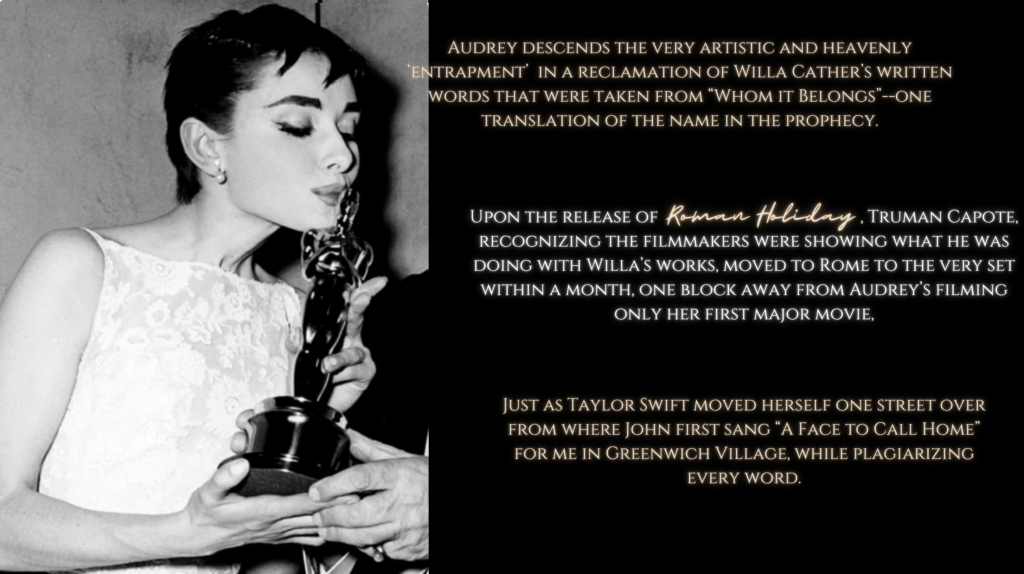
Audrey descends the very artistic and heavenly ‘entrapment’ in a reclamation of Willa Cather’s written words that were taken from “Whom it Belongs”–one translation of the name in the prophecy.
Upon the release of Roman Holiday, Truman Capote, recognizing the filmmakers were showing what he was doing with Willa’s works, moved to Rome to the very set within a month, one block away from Audrey’s filming only her first major movie,